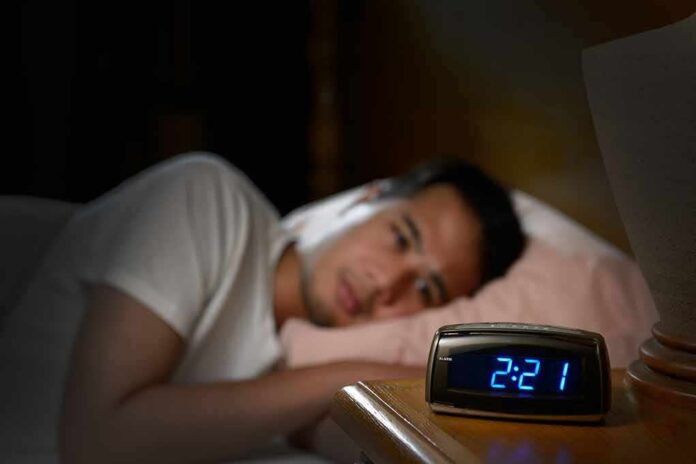
Sleep efficiency, the share of time in bed a man actually spends asleep, starts slipping for most men once they pass 40.
Quick Take
- Sleep efficiency drops roughly 3% per decade after age 40, according to a landmark study of aging men
- Older age links to longer time falling asleep and more nighttime waking, a 2024 study found
- Not every man follows the same pattern — one study found younger men slept less efficiently than older men
- Clinical guidelines back good sleep habits but warn that hygiene tips alone won’t fix real insomnia
What Sleep Efficiency Actually Measures
Sleep efficiency is a simple math problem. Take the total minutes a person actually sleeps and divide it by the total minutes spent lying in bed. A healthy young adult often scores above 90%. Researchers who study large populations have found this number does not hold steady as people age. One major population study put it plainly: efficiency “decreases clearly and significantly with age.”
The Number Behind the Headlines
The most cited figure comes from the Massachusetts Male Aging Study, which tracked sleep patterns in men over time. It found sleep efficiency fell by about 3% per decade starting after age 40. A more recent 2024 study in Sleep Advances backed this up. It found older age linked to lower sleep efficiency, longer time needed to fall asleep, and more time awake during the night, even after researchers adjusted for common health problems.
These findings did not come from guesswork or anecdotes. They came from objective sleep measurements taken across large groups of men tracked over years. That gives the 40-and-up decline real scientific weight, even if it plays out differently for each man.
Why One Study Tells a Different Story
Science rarely agrees on everything, and sleep research is no exception. A 2021 polysomnography study, which records brain waves and body signals during actual sleep, found something unexpected. In that particular sample, younger men showed lower sleep efficiency than older men. The result does not erase the broader trend. It shows that sex, health conditions, medications, and existing sleep disorders can all bend the pattern in individual cases.
Age is a strong signal, not a guarantee. A healthy 55-year-old without sleep apnea or heavy medication use may sleep more efficiently than a stressed, caffeine-heavy 35-year-old. The body’s clock matters, but so does what a man puts into it every day.
What Actually Helps — And What Doesn’t
The American Academy of Sleep Medicine offers advice that lines up with the research. Get up at the same time every day, even on weekends. Skip caffeine after lunch. Avoid alcohol within four to six hours of bedtime, since it causes nighttime awakenings. Build a calming routine before lights out. These habits are simple, cheap, and backed by decades of clinical practice.
But there’s a catch worth knowing. The same organization’s clinical guideline states there is not enough evidence to say sleep hygiene alone cures real insomnia. Good habits help healthy sleepers sleep better. They are not a substitute for treating a diagnosed sleep disorder, which often needs structured therapy or a doctor’s evaluation.
Wearables Add Noise to the Picture
Many men now track their sleep with a watch or ring instead of a sleep lab. These devices can be useful, but researchers caution that accuracy varies by brand and technology. Telling the difference between normal night-to-night variation and an actual sleep disorder remains genuinely hard, even for the devices themselves.
A gadget showing a lower efficiency score one night is not a diagnosis. It is a data point. Men who see consistently poor numbers over weeks, paired with daytime fatigue, have a real reason to talk to a doctor rather than just a new app notification to ignore.
What This Means for Men Approaching Midlife
Turning 40 does not flip a switch that wrecks sleep overnight. It marks the start of a gradual shift backed by real data, one that plays out differently depending on health, habits, and genetics. The practical response is not panic. It is the same advice doctors have given for years: keep a steady schedule, cut late caffeine and alcohol, and see a professional if poor sleep sticks around.
Sources:
menshealth.com, academic.oup.com, pmc.ncbi.nlm.nih.gov, onlinelibrary.wiley.com, aasm.org, tandfonline.com