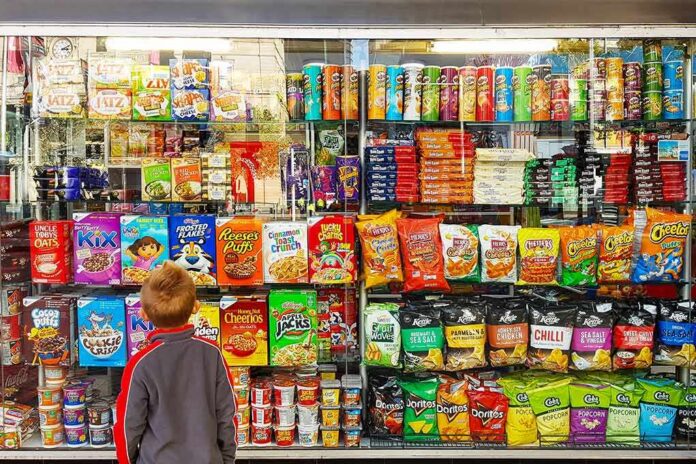
A one-year study of 46 children found that eating more processed snack foods was tied to stronger brain reward signals and more body fat gained by the following year.
Story Snapshot
- Researchers at the University of Southern California studied 46 children ages 7 to 10 who started the study at a healthy weight.
- Kids who ate more ultra-processed foods showed stronger activity in the brain’s dorsal striatum, a reward center, when shown pictures of foods like cookies and fries.
- That stronger brain response was linked to more body fat and a bigger waist circumference one year later.
- The findings appear in JAMA Network Open and add to a growing body of research on diet and children’s brain development.
What The Study Actually Measured
Scientists from the Keck School of Medicine of USC and Kaiser Permanente Southern California tracked 46 children already enrolled in a long-term study on diabetes and obesity risk. All started at a healthy weight. Researchers recorded how much of each child’s daily calories came from ultra-processed foods, then scanned their brains while showing them pictures of appetizing foods like fries and cookies.
The brain region in question, the dorsal striatum, plays a big role in reward and motivation. It’s the same circuitry that lights up for things people find pleasurable or habit-forming. Kids who ate more ultra-processed foods day to day showed stronger activity there when viewing tempting food images, compared to kids who ate less of these products.
The Link Between Brain Activity And Body Fat
One year later, researchers checked back in. Children with the strongest reward-center responses to food pictures had gained more body fat and seen their waist circumference grow more than their peers. The study didn’t just find a snapshot association — it tracked the same kids over time, which lets researchers say the brain pattern came before the weight change, not just alongside it.
Lead researcher Kathleen Page and her team suggest this points to a possible pathway: ultra-processed foods may train young brains to respond more intensely to food cues, which in turn could drive overeating and fat gain. It’s an early but meaningful signal that what kids eat regularly may shape how their brains respond to food long before any weight problem shows up on a scale.
How This Fits The Bigger Nutrition Picture
This isn’t an isolated finding. A broader review of research in children and teens found 14 of 17 studies linked higher ultra-processed food intake to overweight, obesity, or heart and metabolism problems. A separate federal dietary review reached a similar conclusion: diets higher in these foods tend to go along with more body fat in kids, though that evidence is mostly observational.
Observational doesn’t mean meaningless. It means the data shows a strong, repeated pattern without proving the exact chain of cause and effect in a lab-controlled way. Parents don’t need a mechanism diagram to notice what common sense already suggests: food engineered to be irresistible, high in sugar, fat, and salt, is going to be harder for a developing brain to say no to.
Why The Reward Circuit Angle Matters
Not every brain-scan study on food and obesity agrees on the details. A separate meta-analysis of food-picture brain scans in adults found mixed results, with no single clear difference between heavier and leaner people in how their brains reacted to food pictures. That’s a reminder that brain imaging research is still evolving and findings can vary by study design and population.
Still, the broader body of work on reward pathways and food points in a consistent direction for kids specifically. Earlier research found that teens whose brains lit up more for food rewards were more likely to gain fat later on, a pattern this new study echoes. Combined with mounting evidence that these foods are deliberately engineered to be hard to stop eating, the case for limiting kids’ access grows harder to dismiss.
What Parents Can Take From This
No single study settles the debate over ultra-processed food and childhood obesity. But this one adds a biological explanation to something many parents already sense: packaged snacks marketed directly at kids aren’t just empty calories, they may be shaping how young brains respond to food itself. That’s worth factoring into what’s stocked in the pantry.
Public health groups have already flagged how aggressively these products are marketed to children worldwide, making avoidance harder for families even when they want to cut back. As this research area grows, the message for households stays simple: fewer processed snacks, more real food, and a little less trust in anything built in a lab to be impossible to put down.
Sources:
sciencedaily.com, ngp.usc.edu, pmc.ncbi.nlm.nih.gov, sciencesources.eurekalert.org, media.jamanetwork.com, bmj.com, academic.oup.com, nesr.usda.gov, data.unicef.org