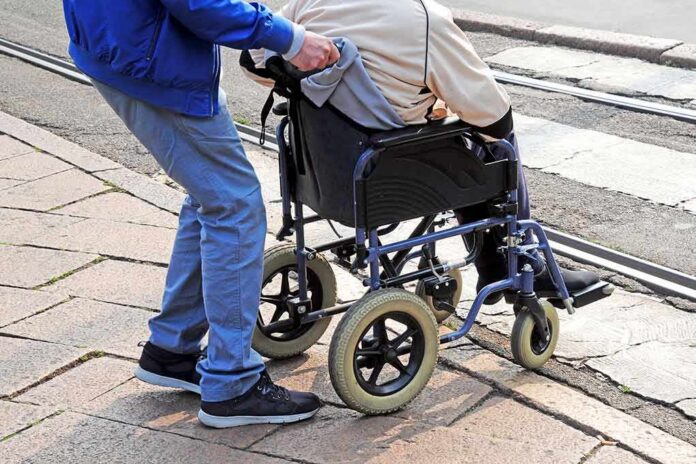
A wheelchair, cane, or rollator should work like a pair of glasses. Nobody questions why someone wears glasses. Yet people who use mobility aids say strangers stop them daily to stare, question, or judge their right to move through the world with help.
Story Snapshot
- People who use wheelchairs, canes, and rollators report frequent staring and invasive public questioning about their disabilities.
- Users with invisible or changing conditions face extra suspicion when their need for an aid is not obvious every day.
- Research links mobility aids to social meanings like dependence and decline, not just physical help.
- Medical bias and inaccessible spaces compound the stigma, shaping whether people use aids they actually need.
What People With Mobility Aids Are Actually Describing
A November 2026 TIME article titled “No One Should Be Shamed for Using a Mobility Aid” lays out a simple point. A properly fitted mobility aid works like an extension of the body. It lets a disabled person join daily life on more equal footing, the same way crutches help someone with a broken leg.
But the reality for many users looks different than that simple comparison suggests. One participant in a 2024 study published in the Disability and Health Journal put it bluntly: “People are weird about it.” She said she often gets stared at or approached by strangers asking invasive questions about why she needs her device. That is not politeness. That is a stranger deciding her body is public property for comment.
Invisible Disabilities Face A Harder Version Of The Same Problem
The stigma hits hardest for people whose disability is not visually obvious or does not look the same every day. Someone who uses a wheelchair some days and walks short distances on others can face accusations of faking it, rather than support for managing a condition that changes hour to hour. Writer Rebekah Taussig, who has been paralyzed since childhood, has described how well-meaning strangers can turn “kindness” into something closer to humiliation.
Disability advocate Eddie Ndopu has written about a similar pattern. Even after achieving public success, he says people still act as though his place is in a hospital or nursing home, not in the rooms where he actually works and lives. That reaction says less about any disabled person’s ability and more about a society still deciding who gets to belong in public space.
Research Shows Mobility Aids Carry Meaning Beyond Function
Scholars studying this pattern find mobility aids rarely get treated as neutral tools. A 2025 study in the journal Humanities and Social Sciences Communications found that wheelchairs, canes, and similar devices often get coded by onlookers as symbols of dependence or decline, not simply as equipment that helps someone get around. That coding, researchers argue, feeds real marginalization and emotional strain for users, separate from whatever physical condition brought them to the aid in the first place.
A focus-group study of 61 older adults found a similar split. Participants valued their mobility devices for the independence they provided, but many also linked the devices to aging, decline, and embarrassment in public. That tension helps explain why some people delay using an aid they clearly need, simply to avoid how others will read it.
Medical Bias Adds Another Layer To The Problem
Stigma toward mobility aid users does not stay confined to sidewalks and shopping aisles. It shows up in medical settings too. One disability advocate noted that “the vast majority of doctors view quality of life for people with disabilities as less than that for people without disability”. That kind of built-in bias can shape whether a patient gets offered a mobility aid at all, or gets steered toward managing pain and limited movement without one.
Wheelchair users surveyed in a separate study described strangers staring at them in public, particularly those who started using a wheelchair as adults rather than growing up with one. That detail matters. It suggests the stigma attaches less to the disability itself and more to the visible symbol of it, the device itself becoming the target of judgment rather than the person using it.
Practical Tools Deserve Practical Acceptance
A wheelchair does for someone’s legs what a car does for everyone’s commute. Nobody demands a driver justify owning a car before pulling out of a driveway. The same basic respect for practical tools ought to extend to the millions of Americans who use mobility aids to work, parent, shop, and worship like anyone else. Dignity shouldn’t require a doctor’s note read aloud to strangers.
Common sense says a tool that helps a person function should be treated as unremarkable, not as an invitation for interrogation. Until public attitudes catch up with that basic logic, people using canes, scooters, and wheelchairs will keep absorbing stares and questions that have nothing to do with their actual lives, and everything to do with other people’s discomfort.
Sources:
time.com, partners.time.com, academia.edu, pmc.ncbi.nlm.nih.gov