Health officials say you should never scrub your toothbrush with soap, soak it in mouthwash, or run it through the dishwasher, even though it picks up bacteria within minutes of each use.
Quick Take
- The Centers for Disease Control and Prevention (CDC) says toothbrushes do not need to be disinfected, only rinsed and air-dried.
- The American Dental Association (ADA) confirms brushes carry bacteria, but no study links that to actual illness in healthy people.
- Heat from dishwashers, microwaves, or ultraviolet devices can damage bristles instead of making brushes safer.
- People with weakened immune systems face different risks and should avoid sharing or touching brushes together.
- Lab studies on cleaning methods show mixed results, showing the science is still catching up to the question.
What Health Agencies Actually Recommend
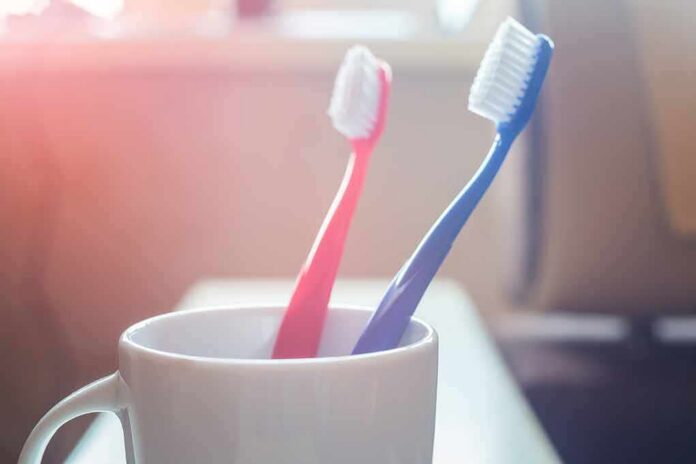
The CDC states plainly that “you do not need to soak toothbrushes in disinfecting solutions or mouthwash.” The agency also says dishwashers, microwaves, and ultraviolet devices aren’t needed to clean a toothbrush. Instead, officials recommend rinsing a brush with tap water until it looks clean, letting it air-dry, and storing it upright so it doesn’t touch other brushes.
This advice sounds strange to anyone who scrubs dirty dishes with hot water and soap every day. But the comparison breaks down once you look at what each guideline is actually built to protect against. Dishwashing targets visible food residue and surface grime. Toothbrush care is built around a different set of findings about germs, health, and durability.
Why Toothbrushes Aren’t Treated Like Dishes
The ADA reports that toothbrushes can harbor bacteria, including fecal coliforms, yet states there is “no evidence that these bacteria cause adverse health effects”. The CDC adds that no published research shows brushing with a contaminated brush actually causes oral infections or other sickness. In other words, germs are present, but a specific health danger hasn’t been proven.
There’s also a practical reason to skip the dishwasher. The ADA warns that microwaving or dishwasher-cleaning a toothbrush isn’t recommended because high heat can damage the brush. A warped or melted brush head won’t clean teeth properly, which could cause more harm than the bacteria it was meant to kill.
The Science Behind Toothbrush Contamination
Toothbrushes start picking up bacteria almost immediately. A review of toothbrush studies found that brushes used by both healthy people and people with oral disease become contaminated with bacteria from plaque, the brush’s design, and the surrounding environment. A newer systematic review found contamination begins after the very first use and builds up the longer a brush is used, with humidity and storage conditions like keeping a brush in a covered container or near a toilet making it worse.
Researchers have tested ways to fight that buildup, with uneven results. One study found an 85% drop in bacteria after soaking brushes in hydrogen peroxide or certain mouthwashes. A separate experiment found dishwasher cycles performed well against bacteria, but only under a specific, controlled setup using a 70-degree-Celsius wash run daily. Neither finding has turned into a general recommendation for home use.
Where the Guidance Gets Complicated
The general “just rinse it” advice isn’t meant for everyone. The CDC specifically flags toothbrush bacteria as a bigger concern for people with weakened immune systems and tells people never to let toothbrushes touch each other or share a brush. That’s a meaningful exception buried inside advice that’s otherwise aimed at the average, healthy household.
Researchers who study hygiene habits say this kind of mismatch between what feels clean and what’s actually risky is common. Surveys cited by public health researchers found that over a third of people treat “cleaning” and “hygiene” as the same thing, even though they aren’t. People often judge germs by sight and smell, not by how likely those germs are to actually make them sick. A toothbrush looks clean after a rinse, even while bacteria remain on it, which is part of why the advice can feel contradictory even though it isn’t.
Sources:
youtube.com, ada.org, consumerreports.org, pmc.ncbi.nlm.nih.gov