Mayo Clinic’s latest summit quietly signaled this: healthcare AI is moving from shiny demo to hard-nosed clinical weapon, and the stakes could reshape who lives, who dies, and who pays.
Story Snapshot
- Mayo’s neurology AI ecosystem is already changing how brain diseases are found and treated[1]
- New tools promise 3–5 times better diagnostic accuracy but still lack outside validation[1]
- AI is targeting “17-year” delays between discovery and cures reaching real patients[1]
- The same AI shift that can save lives can also fuel denial of care and bureaucratic abuse[2]
Mayo Clinic’s AI shift is about speed, brains, and breaking a 17 year logjam
Mayo Clinic’s leaders are not talking about AI as a clever chatbot. They are attacking the slow, clumsy path from discovery to bedside. Dr. Vijay Shah, a Mayo research dean, says their BIONIC initiative exists to crush the typical 17-year delay between a new cure and real-world use, aiming to cut it by a factor of ten through aggressive use of artificial intelligence and business development muscle. For a patient with a fast-moving cancer or dementia, that gap is the difference between hope and hospice.[1]
To move that fast, Mayo is building what is basically a “digital factory” for medicine. The neurology AI program launched in 2019 pulls together brain doctors, data scientists, and software engineers under one roof. Instead of waiting years for scattered trials, they push algorithms into real clinical workflows, then refine them from live data. That multidisciplinary model sounds obvious, but many health systems still keep tech, science, and clinics in separate silos guarded by bureaucracy.[1]
The State Viewer tool hints at what AI can do when it stops being a toy
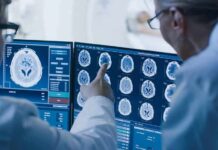
One star of the summit was the State Viewer, a clinical support tool running on the NetD neurology digital ecosystem. Professor David Jones reports that State Viewer boosted diagnostic accuracy three to five times and cut reading time in half across 1,200 scans in only four months. For overwhelmed neurologists drowning in complex brain imaging, that kind of lift changes who gets the right diagnosis the first time rather than after years of mislabeling and failed treatments.[1]
Most readers over forty have watched a friend or parent bounce between “it’s stress” and “maybe it’s dementia.” Mayo says NetD uses cloud-based systems to analyze brain FDG PET scans and separate fourteen different dementia patterns, including some that are reversible and need surgery instead of memory drugs.
Personalized brain surgery and the rise of the medical digital twin
Mayo’s AI work is not just about reading images faster. Their teams mapped individual brain wave patterns in patients with drug-resistant epilepsy and used those unique signatures to guide deep brain stimulation wires more precisely. That approach personalizes surgery to the patient’s own seizure network, instead of using a one-size map downloaded from a textbook. For a family facing repeated seizures and failed medications, custom-targeted stimulation is not a tech buzzword; it is the chance to get their child or spouse back.[2]
Healthcare AI just graduated from "predictive assistant" to "autonomous lab partner". @MayoClinic https://t.co/ejYav82UGK
The Mayo Clinic AI Summit just highlighted the real bottleneck: moving from predictive algorithms to autonomous, multi-agentic workflows running wet lab…— Angela (@LatitudeAlpha) June 29, 2026
From there, the summit pushed toward a bigger idea: the “digital twin” of a patient. Dr. Shah describes a future where a full data model of your body lets doctors test treatments on your digital copy before they touch the real you. Right now this is more vision than proven practice. No clinical outcome data yet shows that digital twin simulations clearly beat standard care. But the concept hits a nerve with anyone sick of being treated as a statistic in a guideline chart instead of as a unique human being.[1]
Where the skepticism kicks in: proof, power, and the risk of AI becoming a gatekeeper
Summit presenters were clear about one uncomfortable fact: most of the dramatic numbers are internal. The State Viewer’s 3–5 times accuracy and 50 percent time savings have not yet gone through independent randomized trials in journals like the Journal of the American Medical Association or Nature Medicine. Regulators and many doctors do not accept “trust us, we measured it” when an algorithm influences whether someone is told they have dementia, cancer, or a benign condition.[1]
There is another tension conservatives will notice. The same artificial intelligence wave that promises lifesaving diagnosis has already been used in billing and prior authorization to deny needed care and cut costs. National medical groups warn that unregulated AI tools now help insurers systematically deny coverage, adding more office visits and forcing patients through failed treatments before they get what works. If the rules do not change, the power of these systems could end up serving the payer more than the patient.[2]
Governance gaps, commercial partners, and the fight over who controls the algorithms
Mayo’s summit talks about multidisciplinary teams and responsible AI, but they do not spell out detailed oversight protocols. Critics point out a missing paper trail on how these systems are governed, audited, and corrected when they fail. There is no public independent audit yet of BIONIC’s governance or NetD’s safety processes. That matters, because once an algorithm becomes a quiet decision-maker, ordinary people cannot easily see or challenge its reasoning.[1]
Financial partnerships add another layer. Mayo openly works with major technology firms and investors to build these tools. That is normal in modern healthcare, but it raises fair questions about influence. Without clear outside checks and peer-reviewed trials, even strong tools can look like black boxes controlled by people who never meet the patient.[1]
Sources:
[1] YouTube – Mayo Clinic summit highlights shift in healthcare AI research
[2] YouTube – Connect to the BIONIC Initiative