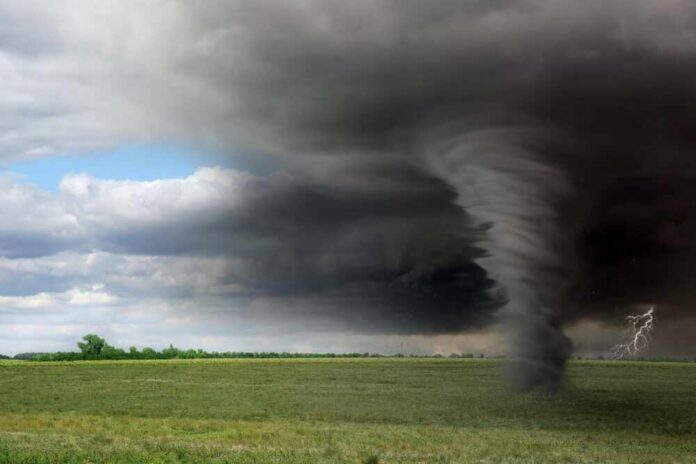
The real story here is not just that tornadoes and wildfires both appeared on the same weather page; it is that the atmosphere can produce simultaneous crises in different regions when the jet stream, frontal boundaries, and dry, windy conditions line up in one broad continental pattern.
Key Points
- The Midwest portion of the story is firmly documented by the National Weather Service: several tornadoes, widespread damaging winds, large hail, and localized flooding were reported in central Illinois on June 17, 2026.[1]
- Official weather analysis attributes that outbreak to a strong low-level jet streak, a warm frontal boundary, and increasing tornado-supportive parameters later in the day.[1]
- Separate official NWS reporting shows that an April 17 outbreak in the Upper Midwest produced 10 tornadoes and was the largest April tornado outbreak ever recorded by that office.[3]
What the Midwest outbreak actually was
In severe-weather terms, the June event was a classic multi-hazard convective outbreak: tornadoes, straight-line wind damage, hail, and flash flooding all emerged from the same storm environment. The National Weather Service in Lincoln reported several tornadoes, wind gusts up to around 80 mph, hail as large as 3 inches, and localized flooding in central Illinois, then explained that thunderstorms formed on the nose of a strong low-level jet streak and tracked along a warm frontal boundary.[1] That is the essential mechanism. When warm, moist air is forced to rise along a boundary and the upper-level wind field strongly supports rotating storms, the result is often not one storm but a family of severe cells, each capable of producing a different kind of damage.
The most important detail in the official write-up is not the headline number of tornadoes; it is the evolution of the atmosphere through the day. The NWS noted that significant tornado parameter values increased into the 4–6 range later in the afternoon, centered farther east in Illinois, after earlier rounds of storms had already reorganized the environment.[1] That matters because severe weather outbreaks are usually not static. One storm cluster can lay down outflow boundaries that become new launch points for later supercells, and a system that begins as a wind event can sharpen into a tornado producer once the local ingredients align.
Why forecasters treated it as a serious outbreak
This was not ordinary summer thunderstorm language. Contemporary coverage from FOX Weather described a rare Level 4 out of 5 severe-weather threat over parts of the Midwest, alongside mid-level winds near 100 mph and the expectation of damaging winds, tornadoes, and severe thunderstorm warnings.[4] CNN similarly described a destructive Midwest outbreak with baseball-sized hail and wind gusts nearing 80 mph.[4] Those descriptions are consistent with a high-end convective setup in which the atmosphere carries enough vertical wind shear and instability to support organized rotating storms rather than brief, pulse-type cells.
Seen in that light, the outbreak belongs to a familiar Midwest pattern. Severe storms there are often driven by the collision of seasonal moisture, strong synoptic forcing, and mesoscale boundaries that become more favorable hour by hour. A broad upper-air disturbance can sharpen the low-level jet, intensify lift along a warm front, and create pockets of extreme local risk even within a region that already looks dangerous on the forecast map. That is why a forecast can sound alarming in the morning and still underestimate the ultimate concentration of damage by evening.
The April outbreak shows the same region, not the same event
The supplied research also contains a separate, earlier outbreak from April 17, 2026, and it should not be folded into the June story. The National Weather Service office in La Crosse called that episode a significant tornado outbreak across the Upper Midwest, said it produced 10 tornadoes, and described it as the office’s largest April tornado outbreak.[3] The same page also reported 26 tornado warnings in one day and preliminary damage reports for more than 100 homes.[3] That is a different event, but it is useful context: the spring 2026 severe-weather season was not a one-off. It was a sequence of outbreaks, each with its own footprint, and the public record becomes muddier when those episodes are collapsed into one composite narrative.
That distinction matters for any serious reading of the season. The April outbreak centered on the Upper Midwest and the June event involved central Illinois and, in other official records, nearby parts of Indiana, Kentucky, Ohio, and Wisconsin.[3][11][12] The fact that they were both substantial tornado-producing systems does not make them interchangeable. In severe-weather analysis, dates and storm survey boundaries are not clerical details; they are the difference between a precise event history and a vague impression of “bad weather somewhere in the Midwest.”
How to read these outbreaks without getting lost in the noise
The deeper lesson is about how severe-weather narratives get built. Real-time livestreams, television hits, and social clips are valuable for immediacy, but they can blur the line between forecast threat, live impact, and later verified survey data.[8][11] That is especially true when multiple outbreak days occur close together, as they did here in April and June 2026. The result is a public record that can sound more unified than it really is. One storm day becomes another, the tornado count slides from one event to the next, and an unverified wildfire linkage can ride along because it fits the same dramatic arc.
The best practice is simpler and stricter: separate the events by date, lean on official storm surveys for the tornado count, and require incident-level fire evidence before treating western wildfire activity as part of the same system. The evidence in this package supports a clear conclusion about the Midwest: the June outbreak was a documented severe-weather episode with tornadoes, damaging winds, hail, and flooding.[1] It also supports a broader seasonal conclusion: spring 2026 delivered repeated tornado outbreaks across the Upper Midwest and adjacent states.[3][11][12] What it does not yet support is a fully verified claim that western wildfires were directly fueled by the same weather system.
Sources:
[1] YouTube – Tornadoes rip through Midwest as high winds fuel wildfires in West
[3] Web – Tornado outbreak of April 17–18, 2026 – Wikipedia
[4] Web – The Tornado Outbreak of April 17 2026 – National Weather Service
[8] Web – Key Messages 17 June 2026 Severe Weather : r/tornado – Reddit
[11] Web – After Tornadoes, Towns in Wisconsin and Illinois Turn to Cleanup
[12] Web – June 17-18, 2026 — Severe Storms and Tornadoes
[18] Web – Weather Patterns in the U.S. and Our Resulting Risk
[24] Web – High-Impact Weather and Climate Events | Western Water Assessment