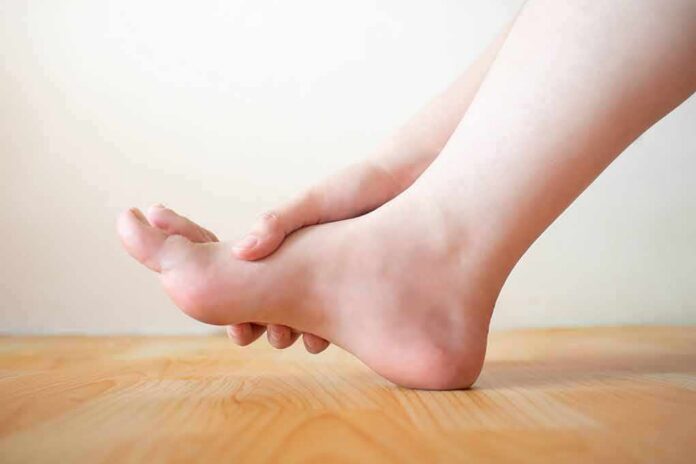
Your feet do not grow after adulthood, but they can still change shape enough to bump you into a new shoe size decades later. That surprising fact comes down to worn-out ligaments, thinning padding, and gravity slowly doing its work.
Quick Take
- Adult feet stop growing in the childhood sense, but their shape can shift gradually with age, according to a Time report on foot health.
- Research cited in the report found foot width and circumference measurements increased by several millimeters per decade.
- Cleveland Clinic doctors say worn ligaments and thinning fat pads cause the arch to flatten, making feet look longer or wider.
- A separate published study found 48% of adults reported at least one shoe size change since reaching full skeletal growth, with the biggest jump between ages 50 and 64.
Why Grown Feet Still Change Shape
Kids’ feet grow because their bones are still forming. Adult feet work differently. Once your skeleton is done growing, the bones themselves mostly stop changing length. But the soft tissue around those bones, the ligaments, tendons, and fat pads, keeps wearing down with every step you take over a lifetime.
That wear shows up as a widening, flattening, or slight lengthening of the foot, not a growth spurt in the traditional sense. Time’s report on the subject says this shift “can happen for a variety of reasons” and does not affect everyone the same way. Some people end up needing a wider shoe. Others need a half size longer.
Cleveland Clinic doctors point to a clear culprit: the arch. Ligaments and tendons that hold your foot’s arch in place get looser and weaker from decades of use. As that support fails, the arch slowly collapses. A flatter foot spreads out, making it measure longer and wider than it did at 25.
The Numbers Behind the Claim
The changes are not just anecdotal. A study cited by Time found that the width of the ball of the foot increased by 3 to 4 millimeters per decade. Ball circumference grew by 5 to 7 millimeters per decade, and heel instep circumference expanded by up to 2 millimeters over the same span.
A separate peer-reviewed study backs up the pattern from another angle. Researchers found adults age 18 to 29 had noticeably smaller foot width and ball circumference measurements than older adults in the study, supporting the idea that feet widen with age rather than staying fixed after young adulthood.
Perhaps the most striking figure comes from a study on adult shoe size change. It found 48% of participants needed at least one size change in foot length after they were done growing. Among people ages 60 to 64, that number jumped to 61%. The researchers pinpointed ages 50 to 64 as the most active window for this shift.
Fat Pads, Weight, and Other Moving Parts
Ligament wear is not the only factor at play. Cleveland Clinic also points to the fat pads on the bottom of your feet, the natural cushioning that absorbs shock with every step. Those pads thin out as you age, changing how a shoe fits even if your bone structure has not moved an inch.
Body weight, pregnancy, and general activity levels all layer on top of age-related wear, which means no two people age through the exact same foot changes. That variability is likely why some people notice a size change by their 40s while others do not feel it until their 60s or later.
It is worth noting one wrinkle in the research. A study out of northwestern Iran found that foot length itself does not change significantly with aging, even as width-related measurements do. That is a useful reminder that “foot size” is really several different measurements bundled together, and they do not all move in lockstep as you get older.
What This Means for Buying Shoes After 40
The practical takeaway is simple: get measured again. Podiatrists and shoe fitters routinely see adults still buying the same size they wore in their 20s, even though their arches have flattened and their fat pads have thinned considerably since then.
Trust your feet over your memory. If shoes that used to fit fine now feel tight across the ball or short in the toe box, that is not your imagination. It is decades of wear catching up with the tissue that holds your foot together, and it is worth a trip to get properly measured rather than forcing your foot into a size that no longer matches reality.
Sources:
time.com, decentfoot.com, pmc.ncbi.nlm.nih.gov, biologyinsights.com