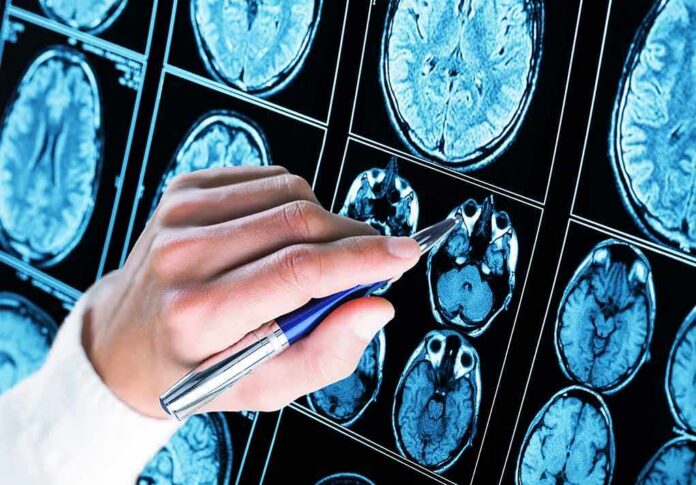
Scientists at Stanford Medicine say the human brain is not one organ, but two, built from separate starter cells that never mix.
Quick Take
- Stanford Medicine researchers say the brain’s front and back come from two entirely different early cell populations.
- One group of cells, marked by a gene called Otx2, builds the forebrain and midbrain; another, marked by Gbx2, builds the hindbrain.
- The team says these two cell groups “never overlap” from the earliest days of development.
- The findings come from mouse embryos studied during gastrulation, the earliest stage of body formation, not from human embryos directly.
- Critics note the adult brain still works as one connected organ, even if it starts from two separate origins.
What The Stanford Team Actually Found
Researchers led by Stanford’s Kyle Loh studied mouse embryos at their earliest stage of growth. They found two groups of starter cells that never blend together. One group builds the forebrain and midbrain. The other builds the hindbrain, the lower part that controls breathing and heart rate.
For decades, textbooks taught that one shared batch of progenitor cells grew into the whole brain, branching out like a tree. Loh’s team says that picture is wrong. Their release describes the hindbrain as following “a separate developmental path, running in parallel to” the pathway that builds the front of the brain, not branching off from it.
Why The Timing And The Genes Matter
The split traces back to gastrulation, the moment an embryo first organizes into layers that become organs. That’s weeks before anything resembling a brain exists. Researchers tagged one cell group with the gene Otx2 and the other with Gbx2, then watched them stay separate through development. Multiple outlets, including Courthouse News and ScienceAlert, repeated the same gene markers within a day of the release, showing the claim spread fast.
The team also found different chromatin structures, meaning the packaging of DNA inside these two cell groups, differed early on. That’s presented as a mechanical reason the two lineages stay locked into separate programs rather than switching paths. If that holds up, it would explain the “never overlap” claim with more than just observation.
Where The Evidence Still Falls Short
Nearly everything the public has seen so far is a news summary of Stanford’s own release, not the full study text, methods, or raw data. That makes it hard to check how strict the “never overlap” boundary really is. No outside lab has published a competing or replicating study yet, so the claim currently rests on one research group’s word.
The mouse-to-human leap is also worth watching closely. Everything described happened in mouse embryos, not human ones, during gastrulation. Mice and humans share a lot of early biology, but confirming the same split happens in developing human embryos would take separate, direct evidence that hasn’t been published yet.
Two Organs Or Two Starting Points
Here’s the sticking point. Saying the brain has two separate developmental origins is different from saying the adult brain is literally two organs. A San Francisco Chronicle report on the same study makes that distinction directly, noting the brain “appears to be a single organ” even though it may begin from two distinct early cell types. That’s a much more careful claim than the eye-catching headline.
Mainstream neuroscience has long treated the brain as one integrated network, with regions constantly talking to each other through wiring built over childhood and beyond. Nothing in Stanford’s findings undoes that. The brain still functions as one connected system once it’s built. What’s new is the claim about how the raw materials get assembled before birth.
This is a real and interesting discovery about biology’s blueprint, not proof that people are walking around with two brains. Readers should treat the “two organs” framing as a bold headline built on a narrower, still-developing scientific finding. The embryology looks solid so far. The leap to rewriting anatomy textbooks needs the full published paper, independent replication, and direct human evidence before it earns that title.
Sources:
mindbodygreen.com, gbnews.com, streamlinefeed.co.ke, sciencenewstoday.org, sciencealert.com, courthousenews.com, developmentstoday.com, el-balad.com